March 10, 2026
At a Look
- A brand new 3D reconstruction of human liver tissue exhibits the organ’s advanced inner structure at a mobile degree.
- The reconstruction illustrates how modifications within the liver’s inner construction could also be linked to liver illness.
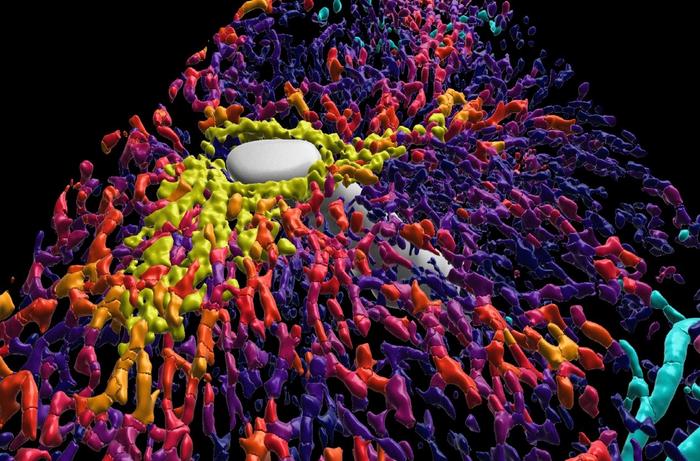
Scientists reconstructed human liver lobules in 3D. The central vein is proven in grey, and the colours present completely different ranges of a key liver enzyme.
Wes Fabyan and Chelsea Fortin
The human liver helps folks keep wholesome in some ways. It helps filter blood and waste, course of and retailer vitamins, produce blood-clotting proteins, resist infections, and fulfills many different essential roles in sustaining the physique’s features.
Wholesome liver tissue is made up of many fundamental elements, referred to as lobules, that every include a central vein, blood vessels, bile ducts, and cells. The association of those elements inside every lobule is essential for the liver to operate correctly. Superior liver illness could cause intensive scarring of the liver, referred to as cirrhosis. Cirrhosis impacts the liver’s inner construction and prevents the liver from functioning correctly.
Researchers don’t absolutely perceive how the liver modifications internally throughout cirrhosis. Present fashions for learning the liver’s construction are principally flat, 2D cultures. These don’t present the organ’s advanced inner 3D construction or the way it modifications throughout liver illnesses.
An NIH-funded analysis group led by Dr. Kelly Stevens of the College of Washington developed a brand new 3D reconstruction of the human liver that exhibits its construction all the way down to a mobile degree. Created utilizing a way referred to as the LiverMap pipeline, the reconstruction may help researchers learn the way the liver modifications internally in liver illness and establish new remedies. The outcomes have been printed in Science Advances on February 18, 2026.
The researchers obtained samples of wholesome liver tissue from six sufferers who had tumors faraway from their livers. Cirrhotic liver tissue was obtained from three sufferers who obtained liver transplants. The researchers handled sections of tissue with fluorescent antibodies to establish completely different cell varieties. In addition they utilized a chemical therapy to show the tissue sections clear.
The sections have been then imaged below a microscope. Pc software program created 3D reconstructions primarily based on the photographs. The 3D reconstructions confirmed how the lobules are structured and the association of veins and arteries at a mobile degree.
The strategy revealed architectural modifications that happen throughout cirrhosis. Cells and blood vessels have been rearranged throughout a number of lobules. Cirrhotic tissue had fewer cells making a key liver enzyme. It additionally had fewer central veins than wholesome liver tissue. The community of ducts that transport bile, a substance that aids digestion, grew to become extra fragmented as properly.
The LiverMap pipeline represents a big advance over prior imaging research. But it surely doesn’t seize the total depth of a human liver lobule. Future analysis will probably be wanted to create a whole lobule reconstruction. Extra analysis additionally might present how structural modifications within the liver evolve as cirrhosis progresses.
The researchers hope that 3D organ maps will finally enable them to make use of 3D printers to construct residing tissues for transplantation. “We don’t but have the ‘blueprints’ of human organs to feed into bioprinters,” Stevens explains. “If the maps aren’t proper, the organs produced is not going to be purposeful.”
—by Sarah Mann
Associated Hyperlinks
References
3D reconstruction of human liver tissue at mobile decision. Fabyan WB, Fortin CL, Goune DL, Kenerson HL, Simmonds Bohorquez SP, Liu JTC, Yeh MM, Carr RM, Yeung RSW, Stevens KR. Sci Adv. 2026 Feb 20;12(8):eadz2299. doi: 10.1126/sciadv.adz2299. PMID: 41706846.
Funding
NIH’s Nationwide Institute of Diabetes and Digestive and Kidney Ailments (NIDDK), Nationwide Institute on Alcohol Abuse and Alcoholism (NIAAA), Nationwide Institute of Environmental Well being Sciences (NIEHS), Nationwide Heart for Advancing Translational Sciences (NCATS), and Nationwide Institute of Basic Medical Sciences (NIGMS); Superior Analysis Tasks Company for Well being (ARPA-H); Nationwide Science Basis (NSF); Howard Hughes Medical Institute (HHMI).