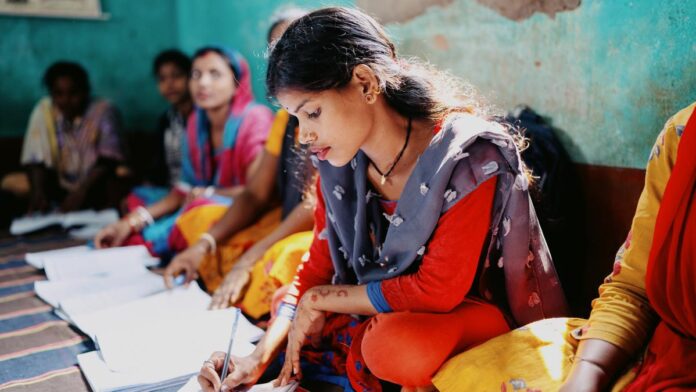
In a quiet residential enclave in Vijayapura, Devanahalli, 40 km from Bengaluru city, an ordinary residence has been converted into a classroom, the walls supporting a mixed population of subjects: On a patch of one wall, Kannada vowels and consonants and scientific drawings enjoy joint tenancy.
As the blackboard becomes busy, the women begin to jot down notes hurriedly. From time to time, someone will take a closer look at the notepad to clear any doubts. At this time, doubts relate to monohybrid crosses and dihybrid crosses. Science teacher Navyanti DN answers patiently.
It is a motley crew of learners, including ASHA workers, a tailor, a young mother looking at the phone with a baby in her lap, lunch workers working in schools and a good number of determined housewives. A Kempegowda International Airport employee rushes to the door around noon; He had asked for permission to leave class early to attend work.
It is one of several learning groups run as part of the Pratham-Jamil Second Chance programme, an initiative of the Pratham Education Foundation, which supports girls and women who have left school before completing secondary education. In Devanahalli block, the program is in its second year.
A study by the Education Ministry states that every year around 24 lakh students fail in Class 10 and a large number of them drop out of the formal education system. Efforts to pursue them up to class XI through the National Institute of Open Schooling (NIOS) have met with modest success. An analysis report of the Ministry of Education was published The Hindu In May 2023, the failure rate is reported to be between 47% and 55%.
In view of this, intervention of NGOs like Pratham becomes important and necessary. Pratham has been bringing ASER (Annual Status of Education Report) since 2005.
Launched as a pilot project in Maharashtra in 2011, the Second Chance program was expanded to seven states. Currently, it is being run in 12 states including Andhra Pradesh, Bihar, Chhattisgarh, Gujarat, Maharashtra, Madhya Pradesh, Odisha, Rajasthan, Telangana, Uttar Pradesh, Tamil Nadu and Karnataka.

After several door-to-door campaigns to enroll women candidates, the new academic year of the Second Chance program started in July 2026 in most cities. The Foundation Course, covering lessons typically taught in upper middle classes, takes three to four months.
Mothers’ groups in the neighborhood help the ground staff to get information about other women or older girls who are interested in completing class ten.
The tasks of their ground staff include convincing family members to support women continuing their studies and maintaining secondary school leaving certificates, regardless of the individual’s age. Persuasion is sometimes targeted at women who have to study.
The challenge of getting women enrolled is different in every state.
“In Tamil Nadu, we find men who prefer that women stay at home; in Rajasthan, women have low confidence levels because they have failed in school, and in Gujarat, many are not allowed to enroll for safety and security reasons,” says Renu Seth, co-head, Girls and Women Programs, Pratham Education Foundation.
Giving girls and women a second chance – whether getting an education or earning a livelihood – creates a multidimensional impact that transforms not just a life, but families and gradually entire communities, says Renu.
They use videos, hold community meetings and share success stories from former students to help them decide to return to the classroom. Many learners hesitate to disclose their enrollment in class 10 for fear of being criticized or made fun of by others.
“Some people will hide their books while going to class and tell family and friends only when they pass,” says Renu.
inspiration from neighbors
Many women who enroll to pass the Class X examination are inspired by working-class neighbours, and some do so to set an example for their children.

A fun learning activity between regular lessons in Himmatnagar (Sabarkantha District), Gujarat. | Photo Credit: Special Arrangement
Twenty-nine-year-old Supritha Rani, a mother of two young girls, wanted to enroll as a lawyer but was refused admission because she did not have an SSLC certificate. “My mother died young, and it was my grandmother who took care of me, but she didn’t have the means to send me to school after a certain age. Now, my husband is very supportive and shares household responsibilities, so I get time to study at home,” says Supritha.
Similarly, Lakshmi, 47, who works as a tailor, has returned to the classroom after three decades. Many of the subjects taught in class are completely new to her, but Lakshmi feels that she can devote more time because she has someone to help her, unlike the times in which she grew up.
Then there is Rudramma M, 51, a single mother who runs a hotel. She failed the English paper this year by two marks, but she is determined not to give up.
After the foundation classes, students move into the “core curriculum”, which focuses on helping learners prepare for the board-mandated curriculum. Progress during this phase is tracked through internal assessment. Interactive methods like activity-based learning, group work and self-learning are adopted in all these months.
pitch a tent
Pratham managed to cover a lot of ground with the help of his many infantrymen. Many of these classes are held in rented spaces, and some spaces are provided free of charge by the community. Sometimes places are also successfully sought in schools.
“We’ve built that trust with the community, so there’s some familiarity in a certain geography. Very rarely do we participate in a completely new geography,” says Soumya Nair, girls and women – strategic partnerships and operations, Pratham Education Foundation.

Life skills-focused activities are also conducted with the learners, focusing on enhancing communication, decision making and critical thinking skills. This picture is of Khandala block, Satara district of Maharashtra
Although classes are held from Monday to Saturday, it is unlike a regular school. There are no penalties and there is a strong emphasis on flexibility so that women are not left out of the program. For example, at the center in Devanahalli, young mothers with children have the option of having them sleep in an adjacent room while attending classes.
Once students move to the main course and are unable to attend classes regularly due to genuine reasons, facilitators are sent to the candidate’s home for home classes.
Before the board exams, government school teachers are invited to motivate the students. In some groups, ground staff take permission from the neighboring school so that candidates can write and take mock exams with regular students to address any concerns. Transportation arrangements are made at the time of examination.
During this one year of board exam preparation, life skills-focused activities are also conducted with the learners, which focus on enhancing communication, decision making and critical thinking skills.
Despite all these measures, it is not easy for women to dedicate a full year to board exam preparation, as many women skip the exam due to various reasons.
Rashmi R., cluster head of Devanahalli block, shares this data: Last year, the cluster enrolled 120 candidates, of whom 75 registered to appear for the Karnataka State Examination Board, but ultimately only 48 appeared for the exam, and 33 passed in all six subjects. “Though classes have started, we continue our mobility activity, with some people from the current batch leading us. Our target is to enroll 100 students this year,” says Rashmi.
Despite dropout rates in different states, Pratham believes the program has made inroads.
To date, the program has impacted over 50,000 girls and women, and the current national pass percentage is 78.
Course content varies from state to state. At least five states follow the National Institute of Open Schooling (NIOS) pattern; Four states adopted State Boards of Open Schooling; And Maharashtra, Tamil Nadu and Karnataka are under the state board, where subjects like Mathematics and English are compulsory.
the way forward
From 2022-23, the Second Chance program is expanding, with more learners appearing for the board exams. The board results have increased from 72% in 2023-2024 to 78% in 2025-26. Maharashtra and Odisha continue to record good performance.
In states where Pratham has been working for a long time, the team collaborates as knowledge partners. The district administration has a database of women who have dropped out of the school education system, making it easier to identify the gaps.

Learning from peers during regular class hours. This picture is from Ghatgaon, Odisha
In 2022, Pratham started with a district-level Rural Livelihood Mission partnership in Nagpur, Maharashtra, where they provided materials, training, mobilization support and assistance throughout the program cycle and helped 175 women complete Class X. “The Rural Livelihood Mission of the Telangana government has partnered with SERP to enroll SHG members for Class 10, and we will support them from beginning to end,” says Soumya.
Soumya says the “change from direct governance to government participation” will help increase the number of women enrolling in class 10 in a year and help them move towards a more sustainable model.
Previously, the program was aimed at helping women who have dropped out of the formal schooling system to help them complete tenth grade; Now, as they’ve cracked that code, it’s expanded in other ways. Many alumni have enrolled for higher education.
Both Soumya and Renu say that subjects like mathematics, science, languages and social sciences are given so much importance in the curriculum that this has generated interest among some women. And Pratham is exploring ways to get such candidates into STEM-related courses.
Disclaimer: The information published in this article is based on official statements, press releases, and verified sources available at the time of publication & Internet. While we strive for accuracy, Nirmal News does not assume responsibility for unverified third-party claims or subsequent developments.