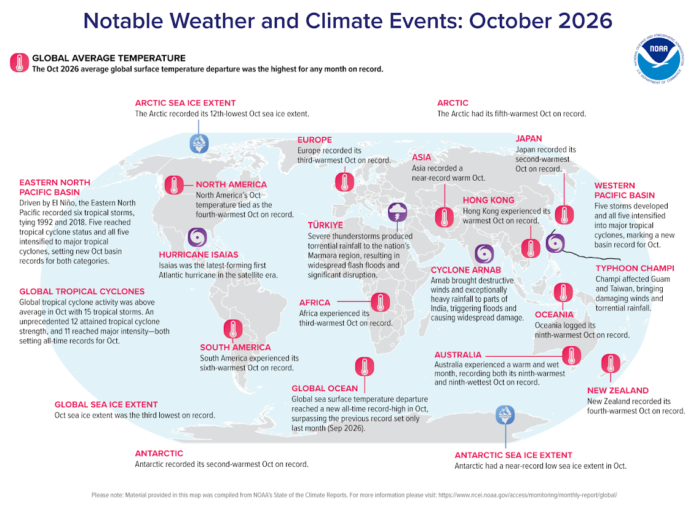
Highlights of October:
- Global surface temperature deviations in October reached an all-time high for any month.
- Sea surface temperatures reached a new all-time high for any month in October 2026, surpassing the most recent record set just one month earlier (September 2026).
- El Niño continued to bring record warmth throughout the central and eastern tropical Pacific, causing significant increases in global ocean temperatures and facilitating the formation of tropical cyclones in the eastern North Pacific basin.
- Globally, 15 tropical storms formed during October. The Pacific Ocean witnessed the lion’s share of global activity, with six tropical storms recorded in the eastern North Pacific and five in the western Pacific.
temperature
Global surface temperatures in October 2026 were 2.57°F (1.43°C) above the 20th century average – the largest temperature departure for any month in the 1850–2026 record. This beats the previous October record set in 2023 by 0.14°F (0.08°C) and the previous similar monthly record set in September and November 2023 by 0.05°F (0.03°C). This is the 50th consecutive October that global temperatures have been above the 20th century average and all 10 warmest Octobers recorded since 2015.

For the fifth consecutive month, global ocean surface temperature changes set a new record, 2.05°F (1.14°C) above the October average. This value represents the highest ocean temperature departure for any month on record, surpassing the previous all-time record set in the previous month, September 2026, by +0.07°F (+0.04°C). This month is the third consecutive month when the sea surface temperature has broken in any month. Ocean temperatures worldwide were much warmer than average, with record-high temperature deviations across wide portions of the central and eastern tropical Pacific Ocean (consistent with the ongoing El Niño), as well as the North Pacific, Atlantic, Indian, and Southern Oceans.
Global land surface temperatures were 3.74°F (2.08°C) above average and the third-highest October temperature in the 177-year record, behind 2023 and 2024. Notable differences in land surface temperatures of more than +3.6°F (+2.0°C) were observed across North America, Northern Europe and parts of Asia, Africa, South America, Africa and Antarctica. Record-high October temperatures were present mainly in South America, Africa and small parts of North America, Asia, and Western Antarctica.
Below average temperatures were limited to Greenland, southern South America, North Africa, Central Asia, Western Australia and parts of Antarctica and the southern Pacific Ocean. However, no land or sea areas experienced record-cold October temperatures.
Continental and polar regions recorded a top 10 warmest October. Asia and the Antarctic region each recorded their second-warmest October. Africa and Europe each recorded their third warmest October, while North America had its fourth warmest October. The Arctic region ranked fifth warmest in October, followed by South America at sixth and Oceania at ninth warmest.
year to date
Looking year-to-date, global surface temperatures in January–October were the second highest on record, at 2.16°F (1.20°C) above average. Only January–October 2024 was warmer at +2.25°F (+1.25°C). According to our Global Annual Temperature Outlook, it is very likely that 2026 will be one of the five hottest years on record, with the highest probabilities favoring the second hottest year on record.
snow cover
Snow cover extent in the Northern Hemisphere in October was 7.07 million square miles, which was below average and near the middle of the historical record. Similarly, the extents of North America (including Greenland) and Eurasia are placed near the middle of their respective records. However, while the extent of Eurasia was only slightly below average, it marked the lowest snow cover extent in October since 2011.
sea ice
Global sea ice extent was the third smallest for October in a 48-year record, covering 8.89 million square miles, 1.04 million square miles less than the 1991-2020 average. The Arctic extent in October was the 12th lowest on record, 310,000 square miles below average. Meanwhile, Antarctic sea ice extent was 730,000 square miles below average and the second-smallest for October. Its scope was small only in October 2023.

tropical cyclone
Global tropical cyclone activity was above average with 15 tropical storms in October 2026. Of these, an unprecedented 12 attained tropical cyclone strength, and 11 reached major tropical cyclone intensity – both all-time records for the month of October.
The Pacific Ocean is responsible for the vast majority of global activity, driven by ongoing El Niño conditions that favor the formation of tropical cyclones. Six tropical storms were recorded for the month in the eastern North Pacific, breaking the October records set in 1992 and 2018. Of those, five reached tropical cyclone status and all five intensified into major tropical cyclones, setting new October basin records for both. In the West Pacific, five storms developed, and all five intensified into major tropical cyclones, a new basin record for October.
In contrast, the Atlantic basin remained quiet with only two tropical storms; However, Hurricane Isaias marked the latest first hurricane of any Atlantic season in the satellite era. Elsewhere, only one tropical storm formed in the North Indian, South Indian, and Southwest Pacific basins.
For a more complete summary of climate conditions and events, see our October 2026 Global Climate Report or explore our Climate at a glance global time series.
Disclaimer: The information published in this article is based on official statements, press releases, and verified sources available at the time of publication & Internet. While we strive for accuracy, Nirmal News does not assume responsibility for unverified third-party claims or subsequent developments.