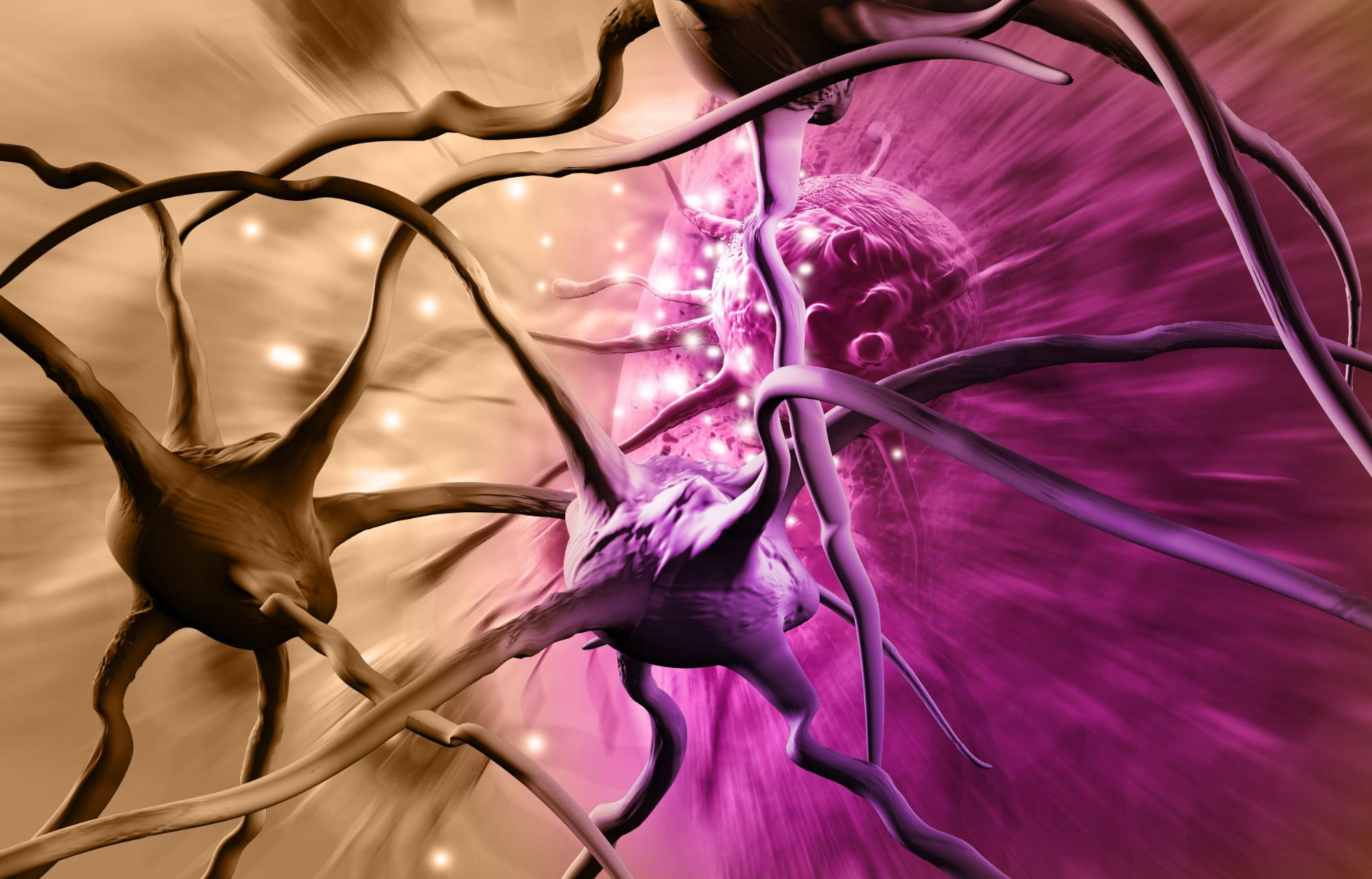
A hidden communication community between mind cells and glioblastoma tumors could also be key to slowing this aggressive most cancers.
Canadian scientists have recognized a beforehand neglected organic course of that might gradual the advance of glioblastoma, the deadliest and most treatment-resistant type of mind most cancers. Their findings additionally level to an current drug that might be able to intervene with this course of, probably accelerating the seek for new therapies.
Glioblastoma is notoriously troublesome to deal with as a result of it quickly invades surrounding mind tissue and adapts to traditional therapies equivalent to surgical procedure, radiation, and chemotherapy. The brand new analysis reveals that the tumor doesn’t act alone. As an alternative, it recruits assist from close by mind cells that had been as soon as believed to play solely protecting roles in wholesome tissue.
The crew discovered that sure mind cells actively talk with most cancers cells, sending molecular indicators that promote tumor development and unfold. When researchers interrupted this signaling in laboratory fashions, tumor development slowed dramatically, revealing a beforehand hidden weak point within the illness.
The outcomes are particularly vital as a result of they counsel a brand new use for an current HIV remedy. Sufferers with glioblastoma at present have very restricted therapy choices, and survival is commonly measured in months, making any potential shortcut to new therapies notably significant.
The examine was printed on Jan. 21, 2026 in Neuron and was led by researchers from McMaster College and The Hospital for Sick Youngsters (SickKids). The co-first authors are Kui Zhai, a analysis affiliate within the Singh Lab at McMaster, and Nick Mikolajewicz, who was a postdoctoral fellow within the Moffat Lab at SickKids on the time of the analysis.
“Glioblastoma isn’t only a mass of most cancers cells, it’s an ecosystem,” says Sheila Singh, co-senior creator of the examine and professor of surgical procedure at McMaster College. “By decoding how these cells speak to one another, we’ve discovered a vulnerability that might be focused with a drug that’s already in the marketplace,” provides Singh, who can be director of the Centre for Discovery in Most cancers Analysis at McMaster.
How Mind Cells Assist Tumors Thrive
Scientists have lengthy identified that glioblastoma varieties dense networks of interconnected cells that help each other, permitting the tumor to develop and resist therapy. This examine got down to decide which regular mind cells develop into a part of that community and the way they contribute to the most cancers’s success.
The researchers centered on oligodendrocytes, a sort of mind cell that usually protects nerve fibers by forming insulation round them. Underneath cancerous circumstances, these cells had been discovered to alter their conduct. As an alternative of supporting wholesome mind perform, they started interacting with tumor cells in ways in which enhanced most cancers development.
This interplay happens via a selected signaling pathway that helps create a tumor-friendly atmosphere. When the researchers blocked this pathway in laboratory experiments, glioblastoma development slowed considerably, demonstrating that the most cancers is determined by this mobile cooperation to outlive.
The invention is especially compelling as a result of the signaling pathway entails a receptor known as CCR5, which performs a job in immune system communication. That very same receptor is already focused by Maraviroc, an HIV drug that’s permitted and extensively used. Repurposing such a drug may shorten the time wanted to maneuver from laboratory findings to scientific testing, since its security profile is already effectively understood.
“The mobile ecosystem inside glioblastoma is way extra dynamic than beforehand understood. In uncovering an essential piece of the most cancers’s biology, we additionally recognized a possible therapeutic goal that might be addressed with an current drug. This discovering opens a promising path to discover whether or not blocking this pathway can velocity progress towards new therapy choices for sufferers,” stated Jason Moffat, co-senior creator of the examine, senior scientist and head of the Genetics & Genome Biology program at SickKids.
Constructing on Earlier Breakthroughs
The breakthrough builds on Singh and Moffat’s 2024 examine printed in Nature Medication, which found {that a} migration path utilized by cells throughout mind growth may be hijacked for most cancers cell invasion. Collectively, these discoveries spotlight a brand new period of glioblastoma analysis centered on dismantling the tumor’s advanced communication networks.
Reference: “Reactive oligodendrocytes promote glioblastoma development via CCL5/CCR5-mediated glioma stem cell upkeep” by Nicholas Mikolajewicz, Kui Zhai, Anish Puri, Petar Miletic, Nazanin Tatari, Jiarun Wei, Neil Savage, Zhi Huang, Qian Huang, Seon Yong Lee, Mahta Jan-Ahmadnejad, Roseanne Nguyen, David Chen, Tiegan Korman, Daniel Mobilio, Maxwell Topley, Jack Qinyu Lu, Matthew R. Voisin, Zsolt Zador, Shawn C. Chafe, Chitra Venugopal, Kevin R. Brown, Gelareh Zadeh, Hong Han, Julien Muffat, Shideng Bao, Sheila Ok. Singh and Jason Moffat, 21 January 2026, Neuron.
DOI: 10.1016/j.neuron.2025.12.012
This analysis work was supported by the 2020 William Donald Nash Mind Tumor Analysis Fellowship and the Canadian Institutes for Well being Analysis. Singh is a Tier 1 Canada Analysis Chair in Human Most cancers Stem Cell Biology and Moffat is the GlaxoSmithKline Chair in Genetics & Genome Biology at The Hospital for Sick Youngsters.
By no means miss a breakthrough: Be part of the SciTechDaily publication.
Comply with us on Google and Google Information.